Four days out of five
81.7%
| Channel | Sampled days | Days with immigration | Share of days | Immigration airtime | Share of own story airtime | Total analysed story airtime |
|---|---|---|---|---|---|---|
| GB News | 60 | 49 | 81.7% | 12h 21m | 20.3% | 60h 43m |
| BBC One West | 63 | 24 | 38.1% | 2h 8m | 2.7% | 78h 18m |
| ITV1 | 64 | 19 | 29.7% | 1h 16m | 2.4% | 52h 48m |
| Channel 5 | 62 | 18 | 29.0% | 42m | 2.7% | 25h 49m |
| Sky News | 62 | 18 | 29.0% | 1h 48m | 2.9% | 62h 29m |
| BBC News channel | 61 | 17 | 27.9% | 1h 26m | 2.1% | 68h 43m |
| Channel 4 | 60 | 14 | 23.3% | 1h 37m | 4.0% | 40h 12m |
| BBC Two (Newsnight) | 44 | 5 | 11.4% | 1h 11m | 5.6% | 21h 21m |
Total analysed story airtime is the denominator for the share column: every story minute each channel recorded in the sample, whatever the topic, immigration included. The share of own story airtime is the immigration figure divided by it.
GB News did not merely spend more minutes on immigration than its rivals: during this sample, immigration appeared more persistently and occupied a substantially larger share of its analysed news agenda. The next-highest frequency was BBC One West’s 38.1%. GB News recorded more immigration airtime than the other seven services combined, whose coverage totalled 10 hours 7 minutes.
The booklet that stayed in the schedule
In mid-August, the Home Office published a booklet telling asylum seekers that rape and child abuse are crimes in the UK. Newsnight covered it first, with a 21-minute segment on 12 August. GB News began covering it two days later and returned to it across six broadcasts between 14 and 23 August, producing 51 minutes of coverage.
The main television bulletins picked up the story on 20 and 21 August. ITV1 broadcast five reports totalling 12 minutes, while BBC One West carried three reports with the same combined duration. Sky News devoted 17 minutes to three reports, the BBC News channel seven minutes to three, and Channel 5 three minutes to two. Across seven channels, the story received about 122 minutes; GB News supplied 51 minutes, more than any other channel and more than the next two combined.
The quotations in this article illustrate differences within selected stories; they are not a systematic coding of framing across every sampled channel. The two booklet discussions framed the document differently. On GB News, a panellist described it as:
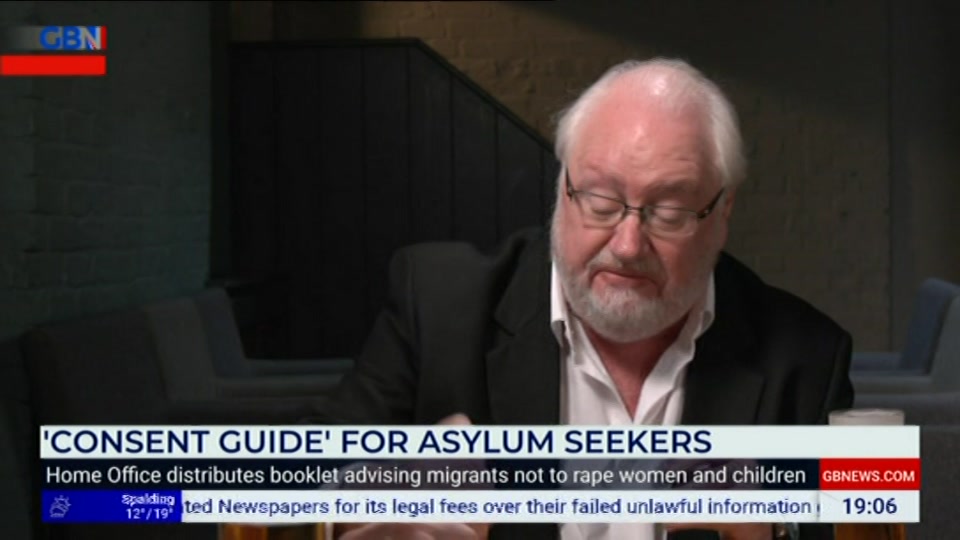
It's basically telling the illegal migrants that's coming over the channel to stop raping women and children.
GB News, New: Lee Anderson's Real World, 21 August 2026, 5:41-5:47
(Lee Anderson's Real World, GB News, 21 August 2026, 19:00; clip 05:41-05:47 into programme)
In the same exchange, the panellist said:
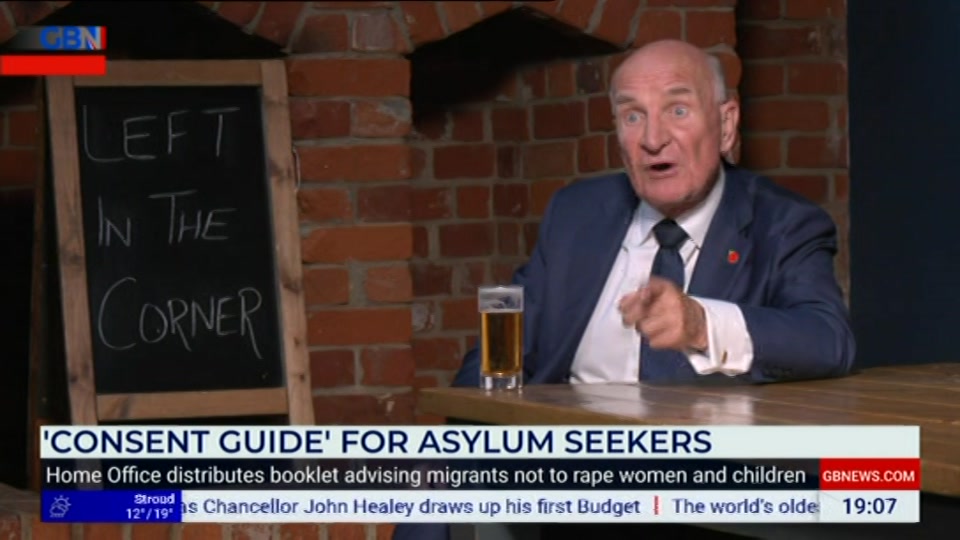
anybody who's gotta be warned not to behave like that should not be coming to our country because of the societal and cultural damage they do to our beautiful United Kingdom.
GB News, New: Lee Anderson's Real World, 21 August 2026, 7:06-7:16
(Lee Anderson's Real World, GB News, 21 August 2026, 19:00; clips 05:41-05:47 and 07:06-07:16 into programme)
Sky News reported the political reaction, quoting Kemi Badenoch’s social media post:
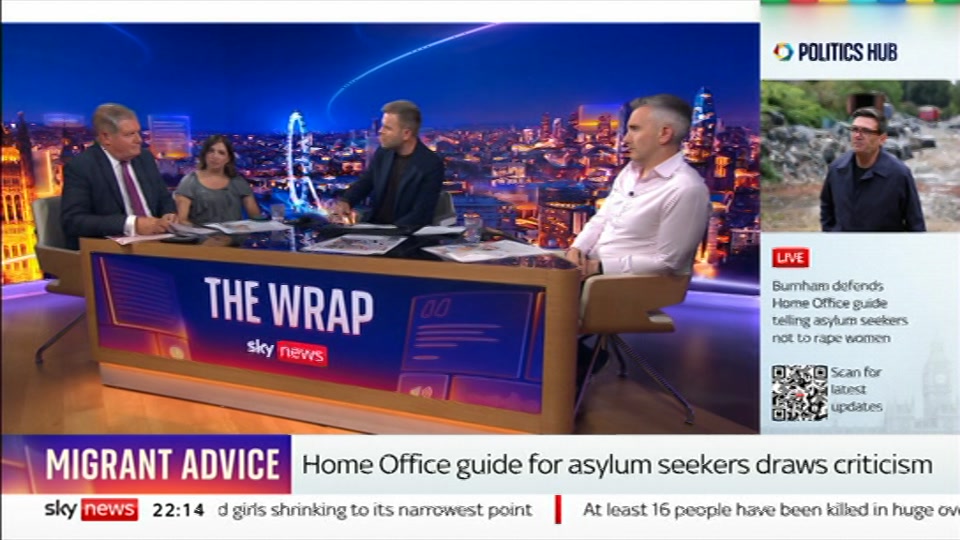
anyone needing this leaflet does not belong in Britain
Sky News, The Wrap With Anna Botting, 20 August 2026, 14:00-14:03
before a studio contributor observed: “for a lot of us here in Britain, it feels like they're stating the bleeding obvious, but I guess that's the point.” (The Wrap With Anna Botting, Sky News, 20 August 2026, 22:00; clip 14:23-14:29 into programme)
Same figures, different treatments
On 27 August, Home Office data showed visas, asylum claims and small boat arrivals all falling. Six channels covered the release for roughly 60 minutes in total. GB News accounted for 34 minutes, followed by the BBC News channel with nine and ITV1 with six. Channel 5, Channel 4 and BBC One West each devoted five minutes or less.
The broadcasters were working from the same figures, but the two programmes did different things with them. On BBC One West, the Home Affairs correspondent reported the government's reading of the data: “the government is very, very optimistic about what these figures show.” (BBC News at One, BBC One West, 27 August 2026, 13:00, clip 15:05-15:10)
GBN Tonight's presenter gave his own assessment of what the figures prove: “That's right, today's data proves that Britain's borders are truly and utterly finally broken.” (GBN Tonight, GB News, 27 August 2026, 19:00, clip 05:55-06:07) It went on to put a figure of its own on non-hotel accommodation: “There are now more than 73,000 illegal immigrants in HMOs on the streets near you.” (GBN Tonight, GB News, 27 August 2026, 19:00) On the government’s removals numbers, it said: “they are really fudging the numbers and fluffing them up” (GBN Tonight, GB News, 27 August 2026, 19:00).
More airtime on the same stories
The largest immigration story in the sample by total analysed airtime concerned four migrants who died in two Channel crossing incidents at the end of July. All eight channels covered the deaths, producing 191 minutes of airtime. GB News accounted for 95 minutes, roughly half the total and more than the next two channels combined.
The repayment policy produced a similar gap. Six channels reported that some asylum seekers could be required to repay up to £10,000 towards accommodation costs. Of 58 minutes recorded across the six, 39 were on GB News.
During that coverage, a panellist disputed the terminology used for those affected: “Let's not call them asylum seekers because it's men fleeing patriarchal systems. Fleeing their wives or what? Fleeing their children.” (Patrick Christys Tonight, GB News, 30 June 2026, 05:00, overnight repeat; clip 14:31-14:43 into programme)
Stories the other seven sampled channels did not carry
Two immigration stories appeared on GB News and on none of the other seven sampled channels. Their absence from this dataset establishes nothing about coverage elsewhere in UK media. One featured a Littleport resident saying that the house next door was being converted into an asylum seeker house in multiple occupation near a school. It ran in four broadcasts on four days between 12 and 17 August, totalling 53 minutes.
The other linked £4.5 million of spending on electric vehicle chargers to the continuation of small boat crossings. GB News carried it in four broadcasts on three days between 5 and 18 August, for a combined 31 minutes. Neither story appeared on any of the other seven channels in the analysed coverage.
What the schedule shows
The distinction is not that GB News covered immigration while the other channels ignored it. All eight covered it. In this sample, GB News carried immigration on more of its sampled days than any other channel, immigration occupied a fifth of its analysed story airtime against 5.6% or less everywhere else, and it devoted more airtime than any other channel to each of the shared stories examined here, from the booklet to the repayment proposal. Two stories unique to GB News added another 84 minutes of immigration coverage. The pattern across all three measures is frequency, relative emphasis and persistence pointing the same way.