Television repeated the phrases at first. But a launch can choose its slogans; it cannot choose which descriptions will still be heard on television ten weeks later. Most of Burnham's launch vocabulary faded. Labels and criticisms elsewhere in the coverage lasted or spread: "coronation", "the great chameleon", "honeymoon", "back to the 1970s". One phrase of his own also endured, the measurable pledge to end rough sleeping. Broadcast Prism examined which vocabulary survived ten weeks of coverage across eight channels, and where the surviving language appeared.
The phrases the launch produced
Burnham's leadership speech on 29 June tried to give the prospective government a vocabulary before it had begun. He promised "the biggest rebalancing of power our country has seen". (BBC News at One, BBC One, 29 June 2026, 13:00) Channel 5 carried it as his own declaration: "We will bring about the biggest rebalancing of power our country has seen." (5 News with Dan Walker, Channel 5, 29 June 2026, 17:00) "Number 10 North will be the nerve centre of a rewired Britain," the BBC report quoted him as saying in the same breath. (BBC News at One, BBC One, 29 June 2026, 13:00)
The launch gave all three phrases immediate reach. By the end of June, "rebalancing" had appeared on four monitored channels, "rewired Britain" on five and "Number 10 North" on six. Burnham had put his vocabulary on television. The more revealing question was which words would remain once coverage moved from launching a government to judging one.
The fade
Two of the three headline phrases disappeared quickly. "Rebalancing" appeared in 21 transcript segments across 12 broadcasts on six days in June and July. Its last appearance was on BBC Two's Newsnight on 30 July. "Rewired Britain" managed three July segments, then nothing. "Number 10 North" faded more slowly, from 117 July segments to 17 in August and three in September.
The labels that persisted
As the launch phrases faded, other people's language proved more durable. On 17 July, a Sky News discussion described the leadership outcome in a single word:
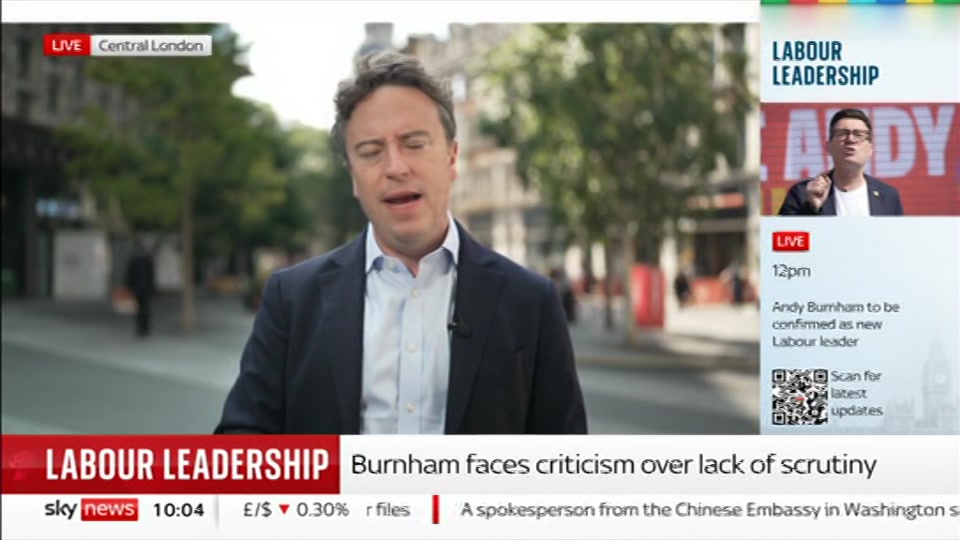
It is a coronation.
Sky News, Sky News Today with Sam Washington, 17 July 2026, 4:20-4:21
(Sky News Today with Sam Washington, Sky News, 17 July 2026, 10:00)
Another Sky News discussion that day reported a politician branding Burnham "the great chameleon of British politics". (Sky News Today, Sky News, 17 July 2026, 16:30)
His first day in office, 20 July, set his own language against the counter-language. In the evening coverage he said "I will give this my all, and I ask you all to pull with me." (GBN Tonight, GB News, 20 July 2026, 19:00) He made a direct pledge: "I will end rough sleeping". (GBN Tonight, GB News, 20 July 2026, 19:00) Later that night: "We have not been good enough and we need to be better. We will be." (Patrick Christys Tonight, GB News, 20 July 2026, 23:00)
The same evening, a GB News discussion offered this description:
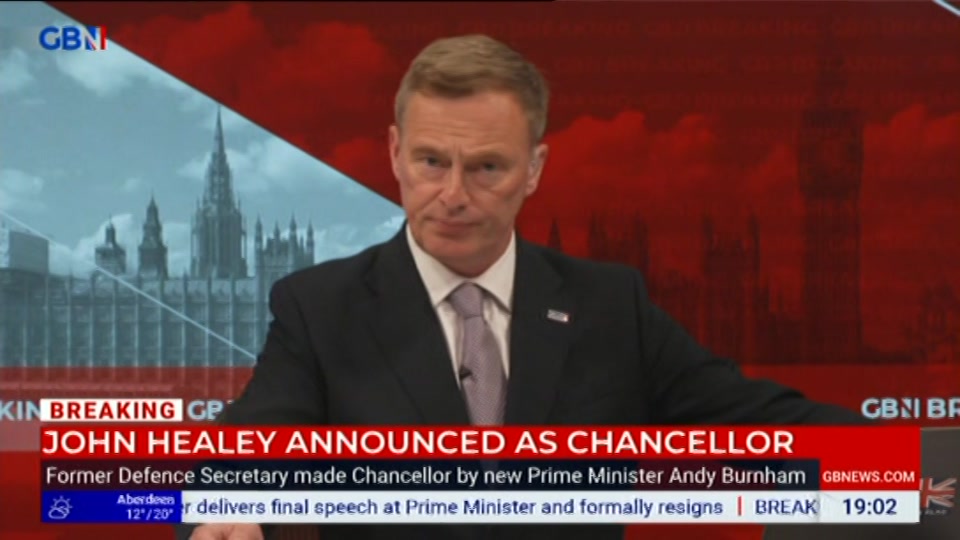
The Messiah, without a mandate
GB News, New: GBN Tonight, 20 July 2026, 1:54-1:59
(GBN Tonight, GB News, 20 July 2026, 19:00)
The discussion also said he had "seized power on pure vibes". (GBN Tonight, GB News, 20 July 2026, 19:00) Two days later, on 22 July, a Sky News discussion was using the word "honeymoon": "he's in the honeymoon stage, he can get away with floating these policies". (Sky News Today with Gareth Barlow, Sky News, 22 July 2026, 10:00)
The quiet month, and the word that grew
Coverage naming Burnham fell from 14.1 hours in the week beginning 20 July to 0.9 hours in the week beginning 3 August. The word "honeymoon" moved the other way: 20 segments in July, 33 in August, the month he was least on-air.
The pledge proved the most durable of his own phrases: it gave broadcasters a measurable commitment they could return to. The exact-string phrase "end rough sleeping" appeared in 39 segments in July, on all eight channels, and 34 in August across six. On 2 August, Sky News reported its own poll: two-thirds of respondents doubted the pledge. Within the monitored corpus, only Sky covered it, in two broadcasts totalling about 17 minutes. By 19 August a BBC report was summarising the pattern: "critics of Andy Burnham say he over-committed and under-delivered there." (BBC News at One, BBC One, 19 August 2026, 13:00)
The attack line that survived the lull
The most sudden revival belonged to "back to the 1970s". It entered the transcripts on 17 July as a Daily Mail headline read out on GB News, recurred once each on Channel 4 and BBC One that month, and until the end of August was never carried by more than one channel in a day. On 1 September, that changed:
Five channels in 24 hours
Coverage also rose again that week. Channel 4 News framed the prime minister's Commons speech as an attempt "to infect the chamber with his signature optimism". (Channel 4 News, Channel 4, 1 September 2026, 19:00) That afternoon, a Sky News discussion replied: "His diagnosis is completely wrong. His theory of growth is completely wrong." (Sky News Today with Jayne Secker, Sky News, 1 September 2026, 16:00) A Sky News discussion gave the 1970s line its fullest form: "He is living in the past and he wants to take us back to the 1970s". (Sky News Today with Jayne Secker, Sky News, 1 September 2026, 16:00) The next morning, a Sky News guest said "he seemed to yearn for the 1970s". (Sky News Today with Gareth Barlow, Sky News, 2 September 2026, 10:00)
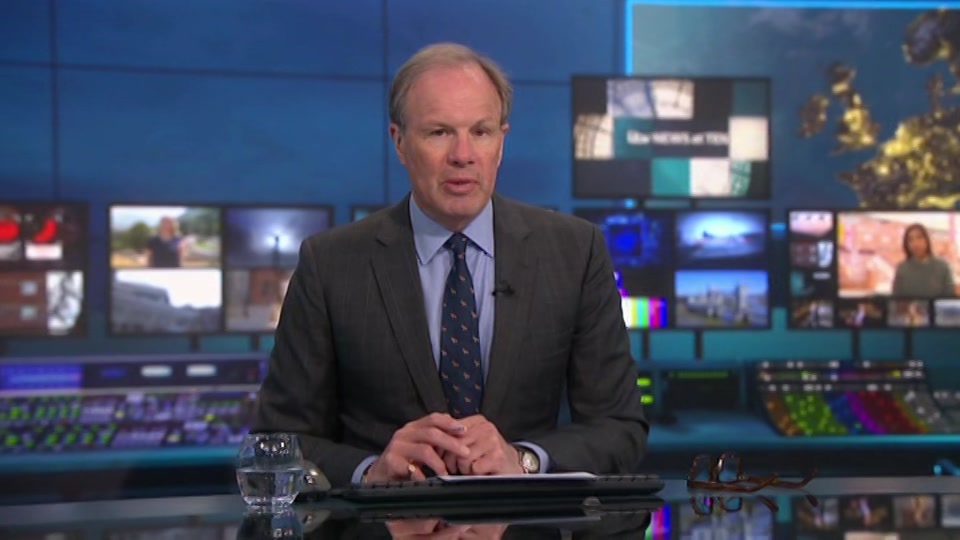
It is fair to say Andy Burnham's honeymoon ended rather abruptly today
ITV, ITV News at Ten, 1 September 2026, 2:11-2:16
(ITV News at Ten, ITV, 1 September 2026, 22:00)
The airtime had declined over several weeks rather than collapsing in a day, returning to 5.8 hours in the week of 31 August. The vocabulary of the revival belonged to the verdict: ITV's lunchtime bulletin the following day reported that "the skies opened and questions rained down". (ITV Lunchtime News, ITV, 2 September 2026, 13:00)
What the counts show
| Phrase | June | July | August | 1-3 September |
|---|---|---|---|---|
| rebalancing | 7 | 14 | 0 | 0 |
| rewired Britain | 9 | 3 | 0 | 0 |
| Number 10 North | 43 | 117 | 17 | 3 |
| end rough sleeping | 0 | 39 | 34 | 0 |
| honeymoon | 2 | 20 | 33 | 13 |
| coronation | 0 | 28 | 9 | 1 |
| to the 1970s | 0 | 7 | 4 | 10 |
The monthly counts are exact-string segment matches, repeated clips included: they show persistence and spread, not independent editorial uses. The "to the 1970s" count captures appearances such as "back to the 1970s". "Rebalancing" never reached the five channels "to the 1970s" covered in a single September day, and "honeymoon" ran on seven channels in August, the trough, against two in June, the launch.
The words that survived were not the broadest claims from the speech. They were the labels, the criticisms and the one measurable pledge. Burnham's launch language described what his government intended to become. The language that outlived it offered ways of judging what it had become. A politician can introduce the vocabulary of a new government, but the record suggests he does not necessarily keep control of it.