US flight cancellations continue as FAA predicts normal service by end of weekend
US airlines are recovering from Friday's four-hour national ground stop, with thousands of flights still cancelled and the FAA expecting schedules to return to normal by the end of the weekend.
How it was covered
- GB News carried 36% of the airtime and concentrated on AI-system speculation, Airspace Intel denial and stranded political events.
- Sky News concentrated on live official statements, cyber-attack fears and Heathrow knock-on effects.
- BBC News concentrated on FAA statements, recovery timeline and ageing US aviation infrastructure.
- BBC Two: not found in tracked broadcasts.
The Full Story
A plain summary built from the channels that reported this story. Facts only one channel reported are attributed to it.
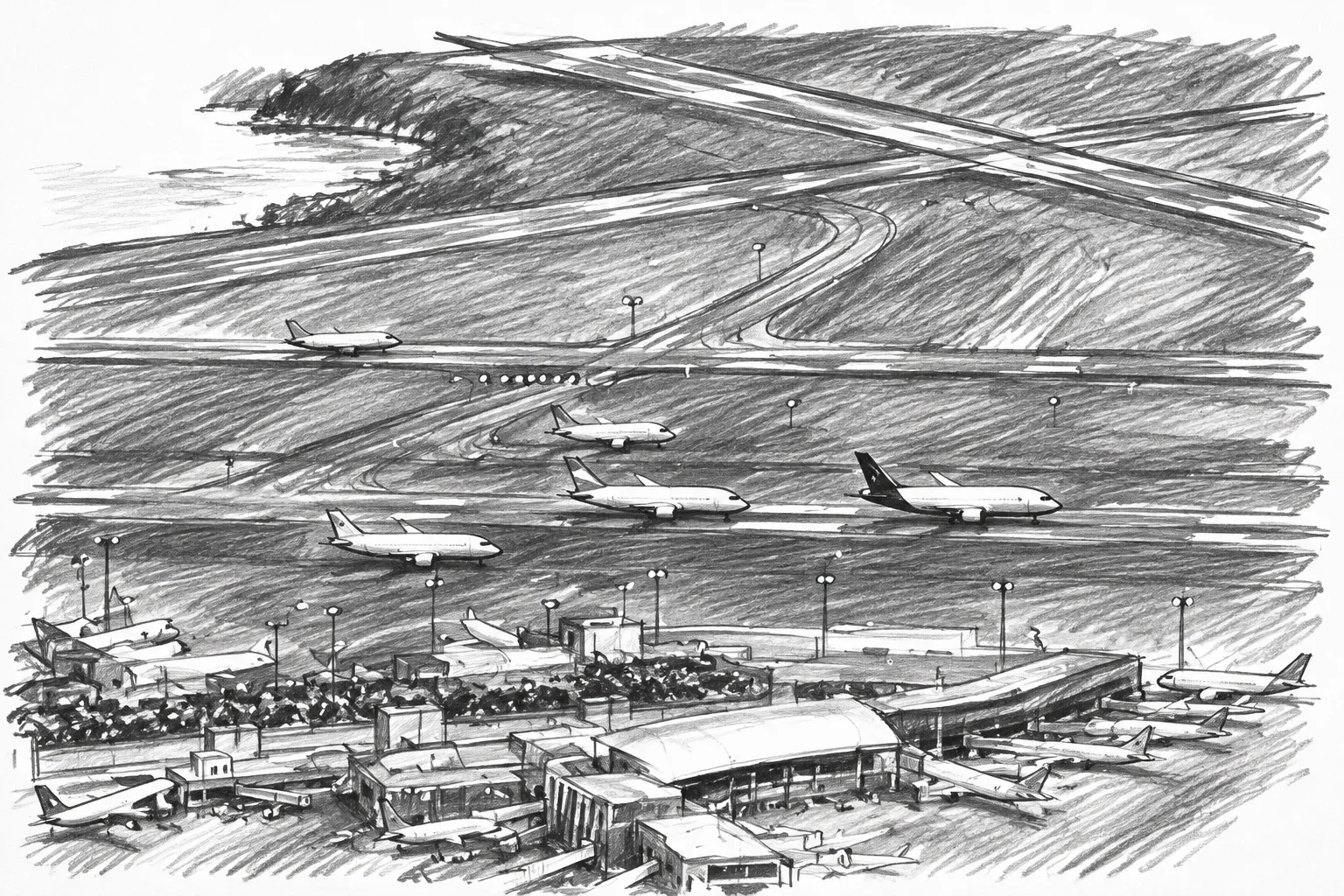
US air travel was still recovering on Saturday after the Federal Aviation Administration ordered a nationwide ground stop on Friday, halting all departures for about four hours. It was the longest such shutdown since the 11 September 2001 attacks. The FAA acted after communications problems affected air route traffic control centres, with Chicago the first to report a local ground stop before the order spread nationwide.
On Saturday, the US transportation secretary, Sean Duffy, said the trigger was routine maintenance at a remote FAA site where a contractor was replacing old copper telecom lines with fibre. He said the work caused more than 1,000 connection attempts every four to five seconds, disrupting communications with aircraft and some radar feeds. Duffy said investigators had not determined whether the fault was a faulty router or an error by contractor L3Harris, and he did not rule out incompetence. The homeland security secretary, Markwayne Mullin, said it was a telecommunications outage and that there was no indication of a cyber attack or a threat to the public. Officials later said there was no evidence linking the outage to Microsoft's global disruption or to rogue AI.
Initial estimates of flights airborne when the order came varied, from about 3,100 to 4,000. Duffy later put the figure at 3,500. The shutdown stranded passengers at airports across the US and disrupted transatlantic schedules. The FAA expected about 4,000 flights to remain cancelled on Saturday and said schedules should return to normal by the end of the weekend, according to BBC News. A tracking website logged more than 6,000 cancelled flights on Saturday, BBC News reported. Sky News reported more than 16,000 delays and cancellations within, into or out of the United States on Friday, while GB News earlier reported nearly 7,000 delayed or cancelled flights, showing how figures changed as the disruption was counted.
UK airports felt the knock-on effect. Sky News reported that the UK Civil Aviation Authority said US flights had resumed but warned of follow-on disruption as airlines rebooked passengers, and advised travellers to check with their airline. At Heathrow, some American Airlines, United Airlines and British Airways services were cancelled, Sky News reported. Passengers described long delays, missed connections and overnight waits. BBC News reported that some people slept at Denver airport because airlines said they could not provide hotels or vouchers after a stoppage they did not cause.
Airspace Intel, the company behind a new smart air traffic system, denied its product was involved, GB News reported. ITV reported that its news producer Jonathan Wald was on a flight in Columbus, Mississippi, that was stopped before take-off and told the next update would not come for at least seven hours. Channel 4 reported that passenger Kayla Tosen had been in transit for 24 hours and was more than $1,000 down. Sky News reported that Paul Charles, founder of the PC agency, said passengers were unlikely to receive compensation because the airlines were not at fault.
Attention turned to the age of the system. Officials and aviation experts said the US network relies on old switches, routers and copper lines, and in some cases floppy disks. The Trump administration called on Congress to find $50 billion for an overhaul. Politicians from both parties demanded an investigation. Former UK air traffic controller Michelle Robson told Sky News that losing communications and radar data was 'the sort of thing that nightmares are made of' for controllers. BBC News reported that Andrew Charlton, managing director of Aviation Advocacy, warned the international knock-on effects could last a week or two.
Key Claims
Claims reported during this story's coverage, grouped by how many channels reported each one. Select a filled dot (or logo) to see the source excerpt. A hollow dot (or faded logo) means the channel reported it but no excerpt is linked.
| Claim |  |  |  |  |  |  |  |
|---|---|---|---|---|---|---|---|
| Widely reported · 6 or more of 7 channels | |||||||
| The FAA issued a national ground stop due to air traffic control communications issues and had halted traffic in Chicago shortly beforehand. | Not reported by Channel 5 | ||||||
| The outage was attributed to old traffic control equipment during a contractor's copper-to-fibre replacement work. | Not reported by GB News | ||||||
| US Homeland Security said there was no indication of a cyber attack or that the country was under attack, and its secretary said there was no reason for public fear. | Not reported by Channel 5 | ||||||
| Reported by a few · 2–5 channels | |||||||
| All 22 regional air traffic control centres were affected by the outage, and no timeline was confirmed for flights to resume. | Not reported by Channel 5 | Not reported by Channel 4 | |||||
| Flights resumed after an outage, though the backlog was expected to take days to clear. | Not reported by Channel 4 | Not reported by GB News | |||||
| The ground stop lasted around four hours and was described as the longest since 9/11, with only three nationwide ground stops in 25 years. | Not reported by Channel 5 | Not reported by GB News | |||||
| The problems were reported not to be linked to the Microsoft outage. | Not reported by Channel 4 | Not reported by GB News | Not reported by ITV | ||||
| Sean Duffy said FAA technicians were investigating the air traffic control communications issue. | Not reported by Channel 5 | Not reported by BBC One | Not reported by Channel 4 | Not reported by GB News | |||
| Broadcasters reported differing figures for the number of flights airborne when the FAA issued its grounding order, including about 1,000 due to land at US airports and about 3,100 overall. | Not reported by Channel 5 | Not reported by BBC News | Not reported by Channel 4 | Not reported by GB News | Not reported by ITV | ||
| FlightAware reported nearly 7,000 delayed or cancelled flights. | Not reported by Channel 5 | Not reported by BBC News | Not reported by BBC One | Not reported by Channel 4 | Not reported by ITV | ||
| More than two million passengers fly in the USA each day. | Not reported by Channel 5 | Not reported by BBC News | Not reported by BBC One | Not reported by GB News | Not reported by ITV | ||
| The homeland security secretary said the ground stop was not another 9-11. | Not reported by Channel 5 | Not reported by BBC News | Not reported by BBC One | Not reported by Channel 4 | Not reported by GB News | ||
| Only on one channel | |||||||
| Airlines were unlikely to pay compensation because the outage was not their fault. | Not reported by Channel 5 | Not reported by BBC News | Not reported by BBC One | Not reported by Channel 4 | Not reported by GB News | Not reported by ITV | |
| Airspace Intel denied that its smart system caused the ground stop. | Not reported by Channel 5 | Not reported by BBC News | Not reported by BBC One | Not reported by Channel 4 | Not reported by ITV | Not reported by Sky News | |
| An expert warned that similar outages are inevitable until systems are modernised. | Not reported by Channel 5 | Not reported by BBC News | Not reported by BBC One | Not reported by Channel 4 | Not reported by GB News | Not reported by Sky News | |
| An update was not expected for at least seven hours, according to Jonathan Wald. | Not reported by Channel 5 | Not reported by BBC News | Not reported by BBC One | Not reported by Channel 4 | Not reported by GB News | Not reported by Sky News | |
| Passenger Kayla Tosen was still in transit after 24 hours and more than $1,000 down. | Not reported by Channel 5 | Not reported by BBC News | Not reported by BBC One | Not reported by GB News | Not reported by ITV | Not reported by Sky News | |
| The transport secretary said about 3,500 planes were airborne during the outage. | Not reported by Channel 5 | Not reported by BBC News | Not reported by Channel 4 | Not reported by GB News | Not reported by ITV | Not reported by Sky News | |
Channel Perspectives
What each channel focused on, with key quotes.
BBC News treated the story as a rolling national and international travel emergency, moving from the first FAA statement to recovery, cause and passenger experience. Its later reporting set the timeline for normal service and highlighted ageing infrastructure, with expert and correspondent analysis. It also gave detailed first-hand accounts from Denver and Reagan National.
- “The US Federal Aviation Administration issued a national ground stop due to extraordinary circumstances and reasons for safety after the agency earlier reported serious air traffic control communications issues.”
- “In at least one of our remote FAA locations, a contractor was doing routine maintenance to switch telecommunication lines from old copper wire and they were bringing it over to fibre.”
- “The Federal Aviation Administration is saying it expects schedules to be back on track by the end of the weekend though.”
BBC One West carried the same BBC reporting but in more compact bulletins, pairing the US shutdown with the separate Microsoft outage and domestic stories. It focused on official reassurance, the rarity of the order and the copper-to-fibre explanation. Later bulletins stressed that 3,500 planes were airborne and that systems were back online.
- “all flights across the US have been halted because of what the Federal Aviation Administration described as extraordinary circumstances and for reasons of safety”
- “a Contractor was doing routine maintenance to switch telecommunication lines from old copper wire and they were bringing it over to fiber”
- “3,500 planes were in the air at the time of the Telecommunications outage”
Sky News gave the most sustained rolling coverage, carrying the Homeland Security press conference in full and repeatedly returning to the question of whether the outage was a cyber attack. It combined official statements with Heathrow disruption, compensation questions and expert analysis from a former UK air traffic controller. Its later reports led on the copper-to-fibre router failure and the rarity of nationwide ground stops.
- “Nationwide ground stops are highly unusual.”
- “This isn't another 9-11. I just can't repeat that enough.”
- “that router that was being replaced as we switched from copper to fiber, it started flooding other routers in our air traffic control system”
ITV1 led on the human disruption and the rarity of the order, with stranded passengers and a first-hand account from ITV producer Jonathan Wald. Later coverage shifted to the cause, the warning that ageing systems make a repeat likely, and the political pressure for investment. Its tone was alarmist about infrastructure resilience but clear on the absence of a cyber attack.
- “This isn't another 9-11. I just can't repeat that enough.”
- “It's only the second time since 9-11 that this has happened.”
- “this isn't just likely to happen, it's inevitable”
GB News reported the story from Denver with a political and passenger-chaos framing, rapidly raising speculation about a newly introduced AI air traffic system. It gave space to Airspace Intel's denial and to large passenger and flight numbers. Its tone was more conversational and alarmist about knock-on economic and political consequences.
- “The current ground stop is not based on or a result of the smart system.”
- “The outage has affected all 22 regional air traffic control centers with no confirmed timeline for flights to resume.”
- “Nearly 7,000 flights have been delayed or canceled.”
Channel 5's short bulletin concentrated on the basic cause and the warning that the backlog would take days to clear. It was less focused on passenger testimony or political blame, and quickly moved on to unrelated domestic stories. It did explicitly rule out a link to the Microsoft outage.
- “flights have resumed but the backlog is expected to take days to clear”
- “US officials said it was caused by old traffic control equipment when a contractor was replacing old copper wire with fibre”
- “Officials confirmed the problems were not linked to the global outage affecting Outlook, email and other Microsoft services.”
Channel 4 framed the outage around infrastructure decay and national vulnerability, asking what adversaries could make of a week of technical failures. It combined the copper-wire explanation with a passenger's financial loss and comparisons to previous FAA failures. Its coverage was more analytical and geopolitical than the rolling news channels.
- “A decision to shut down all flights across the United States, the longest ground stop since the 9-11 attacks in 2001, was down to a copper wire upgrade.”
- “It's been a disaster.”
- “It's like the perfect storm, you have this old clunky hardware that dates back to the 60s, including things like floppy disks.”
Who was on air
People and organisations each channel put on air while covering this story. Channels' own presenters and reporters are not listed. Names as transcribed, and the list can miss people.
- 21:17 GMT
- 21:20 GMT
Sean Duffy, US Secretary
The Context · Fri 13 Nov - 08:04 GMT
Sean Duffy, US Transportation Secretary
BBC News · Sat 14 Nov - 08:09 GMT
Andrew Charlton, Managing Director of Aviation Advocacy
BBC News · Sat 14 Nov - 15:08 GMT
Phil Butterworth-Hayes, consultant and writer specializing in air traffic management, aviation safety, military and civil aviation issues
BBC News · Sat 14 Nov - 05:05 GMT
Dan Bubb, former airline pilot, aviation historian and professor in residence at the University of Nevada Las Vegas Honor College
BBC News · Sun 15 Nov
- 22:43 GMT
Sean Duffy, Transportation Secretary
BBC News · Sat 14 Nov
- 18:32 GMT
- 22:02 GMT
- 22:07 GMT
Markwayne Mullin, Homeland Security Secretary
The Wrap With Gillian Joseph · Fri 13 Nov - 22:28 GMT
Suzy Boniface, investigative journalist
The Wrap With Gillian Joseph · Fri 13 Nov - 22:28 GMT
Kwasi Kwarteng, former Chancellor
The Wrap With Gillian Joseph · Fri 13 Nov - 09:04 GMT
- 09:25 GMT
Emma Henderson, former easyJet captain
Mornings with Jones and Melbourne · Sat 14 Nov - 15:03 GMT
Sean Duffy, the Secretary for Transport
Sky News Today · Sat 14 Nov - 15:04 GMT
Paul Charles, founder and chief executive of the PC agency
Sky News Today · Sat 14 Nov - 15:08 GMT
- 15:08 GMT
Tim Johnston, from the UK Civil Aviation Authority
Sky News Today · Sat 14 Nov - 18:32 GMT
Sean Duffy, US transport secretary
News Hour with Jonathan Samuels · Sat 14 Nov - 18:33 GMT
Michelle Robson, former UK air traffic controller
News Hour with Jonathan Samuels · Sat 14 Nov - 22:11 GMT
Sean Duffy, US transport secretary
The Wrap With Gillian Joseph · Sat 14 Nov - 22:11 GMT
- 23:03 GMT
Airspace Intel, the company behind this new smart system
Patrick Christys Tonight Late · Fri 13 Nov - 23:05 GMT
Markwayne Mullin, US Homeland Security Secretary
Patrick Christys Tonight Late · Fri 13 Nov - 23:13 GMT
- 23:17 GMT
Eliza Williams, stuck at Chicago O'Hare Airport
Patrick Christys Tonight Late · Fri 13 Nov - 23:39 GMT
Nelson Aspen, American journalist
Patrick Christys Tonight Late · Fri 13 Nov - 23:47 GMT
Adam Brooks, Businessman
Patrick Christys Tonight Late · Fri 13 Nov - 23:49 GMT
Barry Gardiner, MP for Brent West
Patrick Christys Tonight Late · Fri 13 Nov - 23:51 GMT
Ada Akpala, Writer and YouTuber
Patrick Christys Tonight Late · Fri 13 Nov
Broadcast Timeline
News broadcasts tracked for this story, in time order.