Rescued gorilla Jojo settles in Gabon sanctuary as experts seek companion
Jojo, a critically endangered Western lowland gorilla rescued from a private zoo, has settled into a forested sanctuary in Gabon, where experts hope to find him a companion.
How it was covered
- BBC News carried 61% of the airtime and concentrated on Jojo's trauma, isolation and the scientific case for a companion.
- BBC One concentrated on a shorter account of Jojo's loneliness and hoped-for companionship.
- Channel 5, Channel 4, GB News, ITV and Sky News: not found in tracked broadcasts.
The Full Story
A plain summary built from the channels that reported this story. Facts only one channel reported are attributed to it.
Jojo, a critically endangered Western lowland gorilla, has settled into a large forested enclosure at Lakedi Sanctuary in Gabon. He was rescued more than 10 years ago from a tiny cage at a private zoo after being taken from the wild as an infant. His mother was killed by poachers, and he has lived almost his whole life alone.
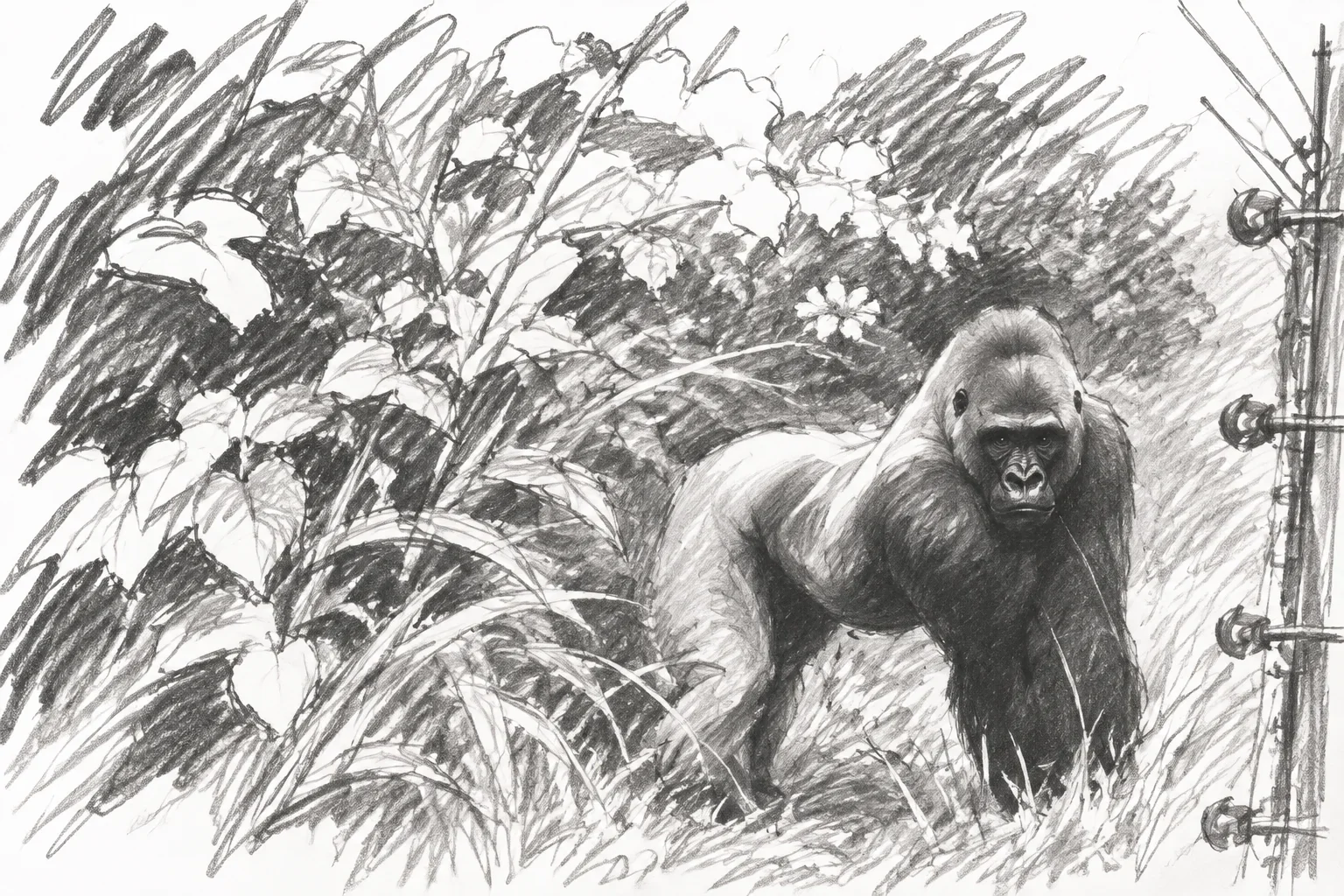
Conservation workers at the sanctuary say Jojo appears lonely. One said: "I would say that he definitely feels lonely. It's evident in him." Gorillas evolved to live in close-knit groups, sitting, eating and sleeping together. Scientists say a companion would give Jojo social connection and could help him recover from severe trauma.
BBC News reported that one researcher described Jojo as "probably the most extreme case of social isolation that I've ever seen". The same report said his psychological recovery would be complex because a young gorilla would normally spend its first 14 to 18 years in a highly complex family unit.
Thermal cameras are changing scientists' understanding of mental wellbeing and loneliness in great apes. They give a colour-coded measure of stress. Calm primates have warm faces, while stress sends blood and heat to the eyes and ears, leaving a cold nose. BBC News reported that Professor Forrester has noticed a chronically cold nose in Jojo. He said: "Their brain circuitry is very similar to ours, and it would be tragic for us not to afford them the same kinds of emotional complexity and depth that we have."
Researchers hope studies of Jojo will help them better understand emotions and psychological recovery in non-human apes. They believe the key to his recovery would be having a friend. BBC News reported that finding him a companion will not be straightforward, because decisions about moving captive gorillas are based on genetics, health and animals' personalities. It also reported that a conservation worker said being alone was "like being cut off from the world. It's like being imprisoned." BBC News reported that there is hope, with careful introduction, that Jojo can finally have a companion. It described him as perhaps the loneliest gorilla in the world.
Key Claims
Claims reported during this story's coverage, grouped by how many channels reported each one. Select a filled dot (or logo) to see the source excerpt. A hollow dot (or faded logo) means the channel reported it but no excerpt is linked.
| Claim |  |  |
|---|---|---|
| Reported by all 2 channels | ||
| A professor reported that chronic harmful stress can manifest as a persistently cold nose, which was observed in Jojo. | ||
| Jojo is a critically endangered western lowland gorilla rescued over 10 years ago from a small cage at a private zoo. | ||
| Only on one channel | ||
| Jojo has lived almost his whole life alone after being taken from his family as an infant when poachers killed his mother. | Not reported by BBC News | |
| Jojo now lives in a large forested enclosure at Lakedi Sanctuary in Gabon. | Not reported by BBC One | |
| Researchers hope studies of Jojo will improve understanding of emotions and psychological recovery in non-human apes. | Not reported by BBC News | |
Channel Perspectives
What each channel focused on, with key quotes.
Compared with the later BBC One bulletin, this channel's coverage was the fullest version, using Victoria Gill's report to explain Jojo's isolation, trauma and the scientific case for a companion. It included Professor Forrester's thermal-imaging observations and the practical hurdles to moving another captive gorilla. The tone was empathetic and explanatory.
- “I would say that he definitely feels lonely. It's evident in him.”
- “I would say he's probably the most extreme case of social isolation that I've ever seen.”
- “Their brain circuitry is very similar to ours, and it would be tragic for us not to afford them the same kinds of emotional complexity and depth that we have.”
Compared with the earlier BBC News version, this channel ran a shorter version of Victoria Gill's report in its afternoon bulletin. It kept the rescue, loneliness and thermal-camera research but left out Professor Forrester, the extreme-isolation quote and the detail on how a companion would be chosen. It closed by telling viewers it would keep them posted on the search, giving the item a lighter rolling-news feel.
- “I would say that he definitely feels lonely. It's evident in him.”
- “Researchers hope studies of Jojo will help them to better understand emotions and psychological recovery in non-human apes but they think the key to Jojo's recovery would be having a friend.”
- “We'll keep you posted on scientists' search for a friend for Jojo.”
Broadcast Timeline
News broadcasts tracked for this story, in time order.